One evening, a group of students watched a space launch on TV. As the countdown ended, a powerful vehicle roared into the sky. One student excitedly said, “That’s a missile!” while another corrected, “No, it’s a rocket!” This simple moment highlights a common confusion. Understanding the difference between missile and rocket is essential because both look similar but serve very different purposes.
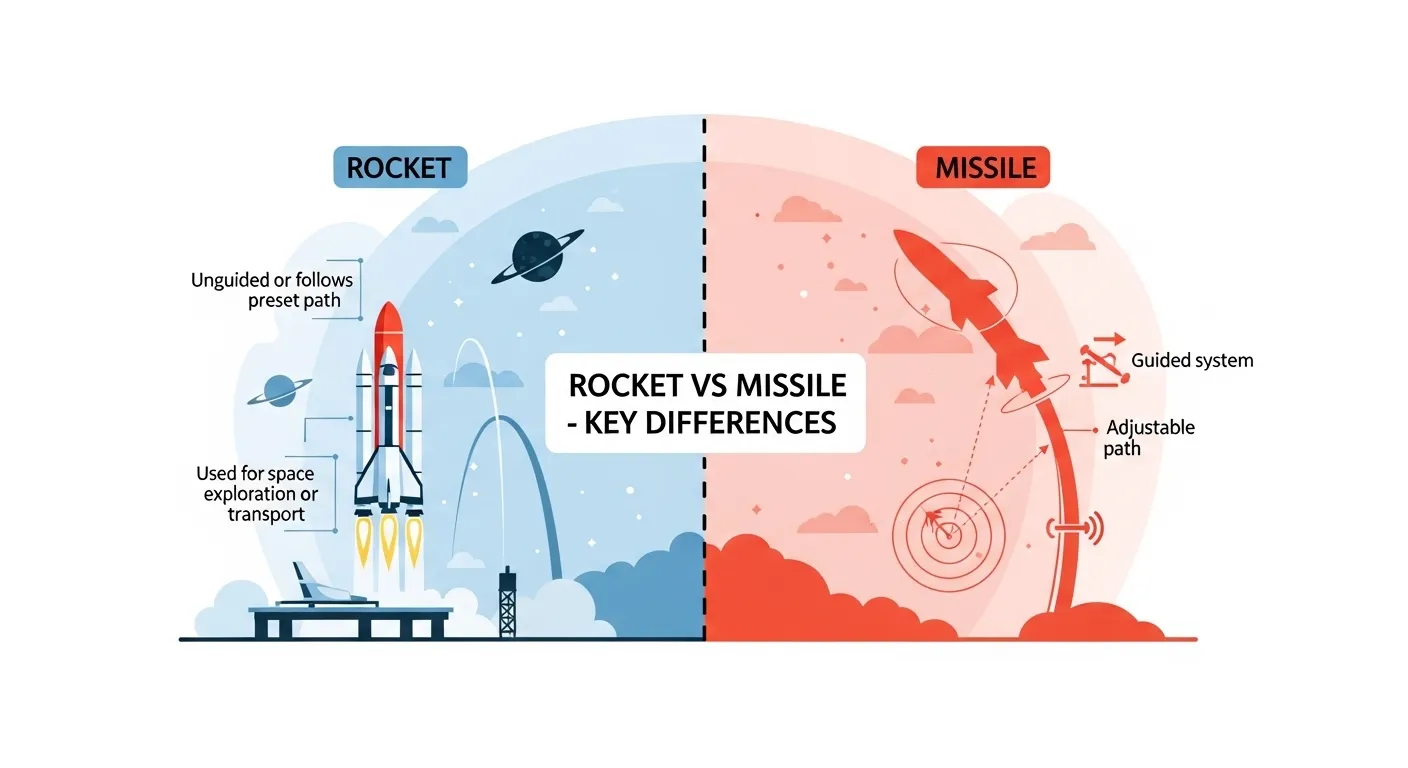
A rocket is a vehicle or device that moves using thrust from expelled gases, often used for space exploration or transportation. A missile, on the other hand, is a guided weapon designed to hit a specific target. The difference between missile and rocket lies mainly in their purpose, guidance, and application. Many learners struggle with the difference between missile and rocket, especially because both share similar technology. Clearly understanding the difference between missile and rocket helps in science, defense studies, and general knowledge.
Key Difference Between the Both
The main difference is that a missile is a guided weapon system, while a rocket is generally an unguided propulsion-based vehicle used for transport or launching objects into space.
Why Is Their Difference Necessary to Know?
Knowing the difference between missile and rocket is important for students, engineers, and even the general public. In society, rockets are symbols of scientific progress and exploration, while missiles are associated with defense and security. Misunderstanding them can lead to confusion in education, media discussions, and global awareness. Experts rely on this distinction for research and innovation, while learners benefit by building clear conceptual knowledge.
Pronunciation (US & UK)
- Missile:
- US: /ˈmɪs.əl/
- UK: /ˈmɪs.aɪl/
- Rocket:
- US & UK: /ˈrɒk.ɪt/
Understanding these basics sets the stage—now let’s explore the detailed differences.
Difference Between Missile and Rocket
1. Purpose
- Missile: Designed as a weapon.
- Example 1: A military missile targets enemy bases.
- Example 2: Air defense missiles intercept threats.
- Rocket: Used for transport or launching.
- Example 1: Rockets launch satellites.
- Example 2: Fireworks rockets create displays.
2. Guidance System
- Missile: Has guidance systems.
- Example 1: GPS-guided missile hits precise targets.
- Example 2: Heat-seeking missile follows aircraft.
- Rocket: Usually unguided.
- Example 1: Fireworks go in a fixed direction.
- Example 2: Basic rockets follow set trajectories.
3. Function
- Missile: Military use.
- Example 1: Used in warfare.
- Example 2: Defense systems rely on missiles.
- Rocket: Scientific or recreational.
- Example 1: Space missions.
- Example 2: Hobby rocketry.
4. Complexity
- Missile: Highly complex systems.
- Example 1: Includes navigation computers.
- Example 2: Has sensors and control systems.
- Rocket: Simpler design (in basic forms).
- Example 1: Firework rockets.
- Example 2: Model rockets.
5. Targeting
- Missile: Targets specific objects.
- Example 1: Enemy vehicles.
- Example 2: Strategic locations.
- Rocket: No specific target.
- Example 1: Carries payload to space.
- Example 2: Used for entertainment.
6. Usage Field
- Missile: Defense and warfare.
- Rocket: Space exploration, research, and entertainment.
7. Control During Flight
- Missile: Controlled mid-flight.
- Rocket: Usually follows pre-set path.
8. Speed Adjustment
- Missile: Can adjust speed and direction.
- Rocket: Limited adjustment once launched.
9. Payload
- Missile: Explosive or warhead.
- Rocket: Satellite, cargo, or astronauts.
10. Examples in Real Life
- Missile: Military defense systems.
- Rocket: Space launch vehicles and fireworks.
Nature and Behaviour
- Missile: Aggressive, precise, and goal-oriented. It reacts to targets and adjusts its path.
- Rocket: Neutral and functional. It follows physics and propulsion without reacting to external targets.
Why People Are Confused About Their Use?
People often confuse them because both use rocket propulsion and look similar during launch. Media and movies also use the terms interchangeably, which increases misunderstanding.
Table: Difference and Similarity
| Feature | Missile | Rocket | Similarity |
| Purpose | Weapon | Transport/launch | Both use propulsion |
| Guidance | Guided | Usually unguided | Use similar engines |
| Usage | Military | Civilian/scientific | Require fuel |
| Target | Specific | Not specific | Travel through air/space |
| Control | Adjustable | Fixed path | Based on thrust principles |
Which Is Better in What Situation?
A missile is better in defense and military situations where accuracy and targeting are critical. It is designed to protect borders, intercept threats, and strike specific targets. In such cases, precision and guidance make missiles essential tools.
A rocket is better for peaceful and scientific purposes such as space exploration, satellite launching, and entertainment. Rockets are ideal when the goal is transportation or discovery rather than destruction. They play a vital role in advancing technology and improving life on Earth.
Use in Metaphors and Similes
- Missile: “His words hit like a missile” (strong and impactful).
- Rocket: “Her career took off like a rocket” (fast growth).
Connotative Meaning
- Missile: Negative (violence, destruction)
- Example: “The situation escalated like a missile strike.”
- Rocket: Positive or neutral (progress, speed)
- Example: “The business grew like a rocket.”
Idioms or Proverbs
- “Rocket science” (something very difficult)
- Example: “Fixing this is not rocket science.”
- No common idiom for missile, but used metaphorically
- Example: “He launched a missile of criticism.”
Works in Literature
- Rocket Boys – Memoir, Homer Hickam, 1998
- The Rocket – Fiction, Ray Bradbury, 1950
- Missile Gap – Science fiction, Charles Stross, 2006
Movies Based on the Keywords
- October Sky (1999, USA) – Rocket theme
- The Rocket (2013, Laos/Australia)
- Missile X: The Neutron Bomb Incident (1978, USA)
FAQs
1. What is the main difference between missile and rocket?
A missile is guided and used as a weapon, while a rocket is usually unguided and used for transport or launch.
2. Are all missiles rockets?
Yes, missiles use rocket propulsion, but not all rockets are missiles.
3. Can rockets be used as weapons?
Some rockets can be weaponized, but they lack guidance like missiles.
4. Why are missiles more advanced?
Because they include navigation, targeting, and control systems.
5. Which is used in space exploration?
Rockets are primarily used for space missions.
How Both Are Useful for Surroundings
Missiles contribute to national security and defense systems, ensuring safety. Rockets help in communication, weather forecasting, and scientific discoveries by launching satellites and spacecraft.
Final Words
Missiles and rockets may share technology, but their roles define them. One protects and targets, while the other explores and advances humanity.
Conclusion
Understanding the difference between missile and rocket is essential in today’s world of technology and defense. While both rely on similar propulsion systems, their purpose, design, and applications set them apart. Missiles are precise, guided weapons used for security, whereas rockets are tools of exploration and innovation. By learning the difference between missile and rocket, students and professionals can better appreciate their roles in society. This knowledge not only clears confusion but also enhances awareness of how science shapes both defense and development.

I am a professional SEO content writer specialising in comparison-based and grammar-focused articles. Through my website GrammarCompare.com, I help readers clearly understand the difference between confusing terms with well-researched, easy-to-read content. My expertise lies in focusing on clarity, accuracy, and practical explanations that improve both knowledge and writing skills.