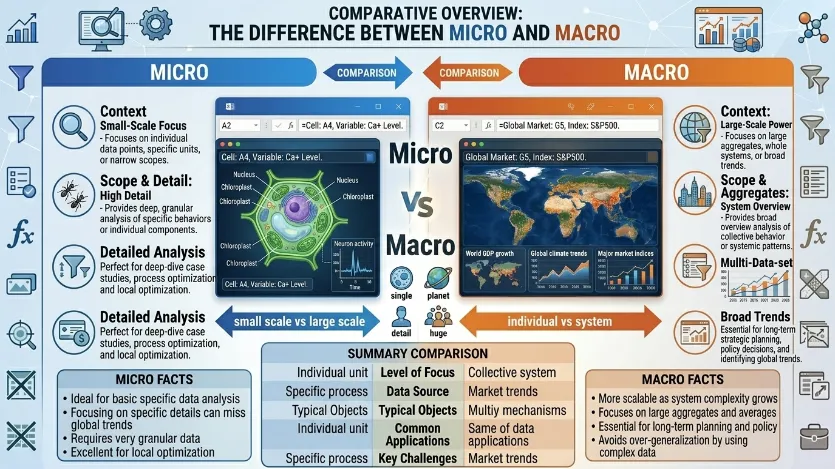
One day, a student named Ali was studying economics and science at the same time. In economics, he learned about small individual decisions like buying a cup of tea—this was called “micro.” In science, he studied tiny organisms under a microscope—again, “micro.” Later, he switched to big topics like national income and global warming, which were called “macro.” Confused, he wondered about the difference between micro and macro.
The difference between micro and macro lies mainly in scale—small versus large. Whether in economics, science, or daily life, understanding the difference between micro and macro helps us see the world from two important perspectives. For students and professionals alike, knowing the difference between micro and macro improves analysis, decision-making, and problem-solving.
Key Difference Between the Both
The key difference is simple:
- Micro focuses on small, individual parts.
- Macro focuses on large, overall systems.
Why Is Their Difference Necessary to Know?
Understanding the difference between micro and macro is important because it helps learners and experts analyze problems more effectively. In society, micro-level thinking helps improve individual behavior, while macro-level thinking helps in policy-making and large-scale planning. Both are essential for balanced growth and understanding.
Pronunciation (US & UK)
- Micro
- US: /ˈmaɪ.kroʊ/
- UK: /ˈmaɪ.krəʊ/
- Macro
- US: /ˈmæk.roʊ/
- UK: /ˈmæk.rəʊ/
Now that you understand the basics, let’s explore the differences in detail.
Difference Between Micro and Macro
1. Scale of Study
- Micro: Small level
- Example 1: A single company’s profit
- Example 2: A person’s spending habits
- Macro: Large level
- Example 1: National economy
- Example 2: Global climate change
2. Focus Area
- Micro: Individual units
- Example 1: A single consumer
- Example 2: One firm
- Macro: Entire system
- Example 1: Total market demand
- Example 2: Entire industry
3. Decision Making
- Micro: Personal decisions
- Example 1: Choosing a product
- Example 2: Setting product price
- Macro: Policy decisions
- Example 1: Government taxation
- Example 2: Interest rates
4. Data Type
- Micro: Detailed data
- Example 1: Customer preferences
- Example 2: Employee performance
- Macro: Aggregated data
- Example 1: GDP
- Example 2: Inflation rate
5. Scope
- Micro: Narrow scope
- Example 1: Local shop analysis
- Example 2: Classroom behavior
- Macro: Broad scope
- Example 1: National education system
- Example 2: Global trade
6. Application
- Micro: Daily life decisions
- Example 1: Budget planning
- Example 2: Diet choices
- Macro: Strategic planning
- Example 1: Economic policies
- Example 2: Environmental laws
7. Tools Used
- Micro: Simple tools
- Example 1: Surveys
- Example 2: Observation
- Macro: Complex models
- Example 1: Economic models
- Example 2: Statistical analysis
8. Time Frame
- Micro: Short-term
- Example 1: Daily expenses
- Example 2: Weekly sales
- Macro: Long-term
- Example 1: Economic growth
- Example 2: Climate trends
9. Behavior Analysis
- Micro: Individual behavior
- Example 1: Buying habits
- Example 2: Work performance
- Macro: Collective behavior
- Example 1: Consumer trends
- Example 2: Population growth
10. Examples in Fields
- Micro: Biology (cells)
- Example 1: Bacteria study
- Example 2: Cell structure
- Macro: Biology (ecosystems)
- Example 1: Forest ecosystem
- Example 2: Ocean systems
Nature and Behaviour
- Micro: Focused, detailed, and precise. It studies small parts carefully.
- Macro: Broad, general, and holistic. It studies overall patterns and systems.
Why People Are Confused About Their Use?
People often confuse micro and macro because both are used in many fields like economics, science, and management. The terms remain the same, but their application changes depending on context, which creates confusion.
Table: Difference and Similarity
| Aspect | Micro | Macro | Similarity |
| Meaning | Small scale | Large scale | Both are analytical tools |
| Focus | Individual units | Whole system | Both study relationships |
| Scope | Narrow | Broad | Both used in many fields |
| Data | Detailed | Aggregated | Both use data |
| Purpose | Specific analysis | General overview | Both aid decision-making |
Which Is Better in What Situation?
Micro is better when you need detailed and specific information. For example, if a business wants to understand customer preferences or improve product quality, micro analysis is more useful. It helps in making precise decisions and solving individual problems effectively.
Macro is better when dealing with large-scale issues. Governments and organizations use macro analysis to plan policies, manage economies, and address global challenges. It provides a bigger picture and helps in long-term planning and strategy development.
Metaphors and Similes
- Micro is like a microscope, focusing on tiny details.
- Macro is like a telescope, viewing the big picture.
- “He thinks micro like an ant but plans macro like an eagle.”
Connotative Meaning
- Micro: Neutral to positive (detail-oriented)
- Example: “She has a micro-level understanding of the project.”
- Macro: Positive (big-picture thinking)
- Example: “He is a macro thinker who plans for the future.”
Idioms or Proverbs
(Not many direct idioms exist, but related expressions include:)
- “Big picture thinking” (macro)
- Example: She focuses on big picture thinking in business.
- “Details matter” (micro)
- Example: In design, details matter the most.
Works in Literature
- Microeconomics Theory – Academic, Various Authors, 20th century
- Macroeconomics – Academic, N. Gregory Mankiw, 1992
Movies Related to the Concepts
- Microcosmos (1996, France)
- Inside Job (2010, USA – macroeconomic theme)
Frequently Asked Questions
1. What is the basic difference between micro and macro?
Micro is small-scale; macro is large-scale.
2. Are micro and macro used only in economics?
No, they are used in science, business, and daily life.
3. Which is easier to understand?
Micro is often easier because it deals with simple, small examples.
4. Can both be used together?
Yes, they complement each other.
5. Why are they important?
They help in understanding both details and the bigger picture.
How Both Are Useful for Surroundings
Micro helps improve individual actions like saving money or managing time. Macro helps improve society through policies, economic growth, and environmental protection. Together, they create balance in personal and social development.
Final Words for Both
Micro and macro are two sides of the same coin. One focuses on details, the other on the whole system. Both are essential for complete understanding.
Conclusion
The difference between micro and macro is not just about size—it is about perspective. Micro helps us understand the small building blocks of life, while macro helps us see the bigger picture. Both are equally important in education, professional fields, and daily decision-making. By mastering the difference between micro and macro, individuals can develop a balanced approach to problem-solving. Whether you are a student, researcher, or professional, understanding both concepts ensures clarity, depth, and better judgment in every situation.

I am a professional SEO content writer specialising in comparison-based and grammar-focused articles. Through my website GrammarCompare.com, I help readers clearly understand the difference between confusing terms with well-researched, easy-to-read content. My expertise lies in focusing on clarity, accuracy, and practical explanations that improve both knowledge and writing skills.