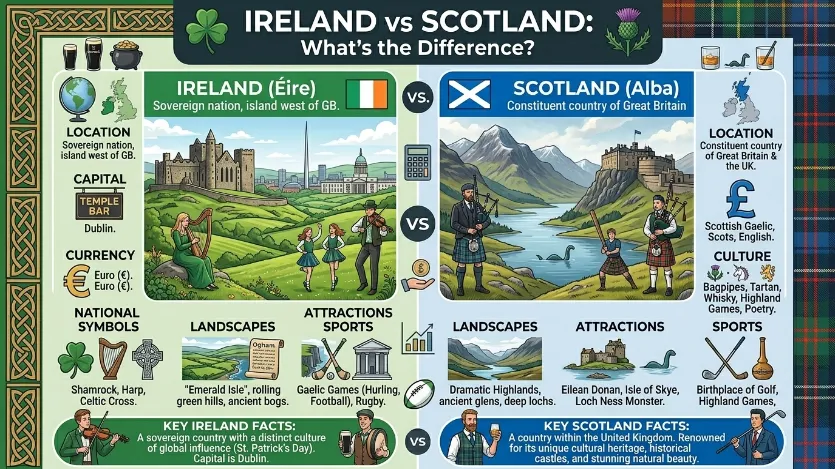
When people hear about Ireland and Scotland, they often imagine green landscapes, historic castles, and rich cultural traditions. A traveler once shared how he planned a trip thinking Ireland and Scotland were almost the same—only to discover completely different identities, accents, and histories. This common confusion highlights the importance of understanding the difference between Ireland and Scotland.
The difference between Ireland and Scotland is not just about geography; it includes culture, politics, language, and identity. Knowing the difference between Ireland and Scotland helps learners, travelers, and experts better understand European history and society. In fact, recognizing the difference between Ireland and Scotland can prevent misunderstandings and enrich your knowledge of global cultures.
Key Difference Between the Both
The main difference lies in political status: Ireland is an independent country (with Northern Ireland part of the UK), while Scotland is a country within the United Kingdom.
Why Is Their Difference Important for Learners and Experts?
Understanding the difference between Ireland and Scotland is essential because it shapes how we view history, governance, and cultural identity. For learners, it builds accurate geographical and political awareness. For experts, it deepens insights into colonial history, national identity, and regional development. These differences influence language, traditions, and even global relations, making them important in education, tourism, and diplomacy.
Pronunciation (US & UK)
- Ireland
- US: /ˈaɪr.lənd/
- UK: /ˈaɪə.lənd/
- Scotland
- US: /ˈskɑːt.lənd/
- UK: /ˈskɒt.lənd/
Now that we’ve set the stage, let’s explore the detailed differences between these two fascinating places.
Difference Between Ireland and Scotland
1. Political Status
Ireland is an independent nation, while Scotland is part of the UK.
- Example 1: Ireland has its own president and government.
- Example 2: Scotland shares governance with the UK Parliament.
2. Geography
Ireland is an island; Scotland is part of Great Britain.
- Example 1: Ireland is surrounded by the Atlantic Ocean.
- Example 2: Scotland shares land borders with England.
3. Currency
Ireland uses the Euro; Scotland uses the British Pound.
- Example 1: Shopping in Dublin uses euros.
- Example 2: Buying goods in Edinburgh uses pounds.
4. Capital Cities
Ireland’s capital is Dublin; Scotland’s is Edinburgh.
- Example 1: Dublin is Ireland’s largest city.
- Example 2: Edinburgh is known for its historic castle.
5. Language
Both speak English, but accents and native languages differ.
- Example 1: Irish Gaelic is used in Ireland.
- Example 2: Scottish Gaelic exists in parts of Scotland.
6. History
Ireland has a history of independence struggles; Scotland joined the UK.
- Example 1: Ireland gained independence in 1922.
- Example 2: Scotland united with England in 1707.
7. Culture
Both have Celtic roots but distinct traditions.
- Example 1: Irish culture emphasizes folklore and dance.
- Example 2: Scottish culture includes bagpipes and kilts.
8. Religion
Ireland has a strong Catholic influence; Scotland is more Protestant.
- Example 1: Catholic traditions are prominent in Ireland.
- Example 2: Presbyterianism is common in Scotland.
9. Landscape
Ireland is known for rolling green hills; Scotland has rugged highlands.
- Example 1: Ireland is called the “Emerald Isle.”
- Example 2: Scotland features dramatic mountains.
10. National Identity
Ireland identifies as fully independent; Scotland has mixed identity within the UK.
- Example 1: Irish citizens identify with a sovereign nation.
- Example 2: Some Scots support independence movements.
Nature and Behaviour
Ireland is often seen as warm, friendly, and deeply rooted in storytelling traditions. Scotland, on the other hand, is perceived as proud, resilient, and strongly connected to its heritage and independence movements.
Why Are People Confused?
People confuse them due to similar landscapes, shared Celtic heritage, and geographic closeness. Media portrayal and accents also contribute to misunderstanding.
Difference and Similarity Table
| Feature | Ireland | Scotland | Similarity |
| Status | स्वतंत्र देश | UK का हिस्सा | यूरोप में स्थित |
| Currency | Euro | Pound Sterling | आधुनिक अर्थव्यवस्था |
| Culture | Irish traditions | Scottish traditions | Celtic roots |
| Language | English, Irish Gaelic | English, Scottish Gaelic | English widely spoken |
| Landscape | Green hills | Highlands, mountains | Natural beauty |
Which Is Better in What Situation?
Ireland is better for those who enjoy peaceful countryside, literary history, and a strong sense of independent national identity. It offers a relaxed atmosphere and welcoming culture, ideal for tourists seeking calm experiences.
Scotland is better for those interested in dramatic landscapes, historic castles, and a mix of modern and traditional British culture. It suits travelers who enjoy adventure, hiking, and exploring political history.
Metaphors and Similes
- Ireland is like a “green poem,” full of rhythm and softness.
- Scotland is like a “strong fortress,” bold and enduring.
Connotative Meanings
- Ireland: Positive (warmth, friendliness), Neutral (rural), Negative (historical struggles)
- Example: “Ireland feels like home.”
- Scotland: Positive (strength, pride), Neutral (cold climate), Negative (harsh weather)
- Example: “Scotland stands strong against time.”
Idioms and Proverbs
- “Luck of the Irish” – unexpected good fortune
- Example: He won the lottery—true luck of the Irish!
- “Scottish thrift” – careful spending
- Example: Her budgeting shows real Scottish thrift.
Works in Literature
- Ireland
- “Ulysses” – James Joyce (Modernist, 1922)
- “Dubliners” – James Joyce (Short stories, 1914)
- Scotland
- “Macbeth” – William Shakespeare (Tragedy, 1606)
- “Treasure Island” – Robert Louis Stevenson (Adventure, 1883)
Movies
- Ireland
- “The Wind That Shakes the Barley” (2006, Ireland/UK)
- “Brooklyn” (2015, Ireland/UK)
- Scotland
- “Braveheart” (1995, USA/UK)
- “Outlaw King” (2018, UK)
FAQs
1. Are Ireland and Scotland the same country?
No, Ireland is independent while Scotland is part of the UK.
2. Do they speak the same language?
Both speak English, but accents and Gaelic languages differ.
3. Which is bigger?
Ireland is larger as an island, but Scotland is part of a larger landmass.
4. Can you travel easily between them?
Yes, by ferry or flight.
5. Why are they culturally similar?
Because both share Celtic roots.
How Both Are Useful for Surroundings
Ireland contributes to global culture through literature, music, and tourism. Scotland adds value through education, innovation, and historical preservation. Both enrich global diversity and cultural understanding.
Final Words
Ireland and Scotland are unique in their own ways. While they share similarities, their differences define their identities and global significance.
Conclusion
Understanding the difference between Ireland and Scotland helps us appreciate their unique identities beyond stereotypes. From political systems to cultural traditions, each has its own story to tell. Ireland stands as a symbol of independence and cultural warmth, while Scotland represents resilience and historical pride within the UK. By learning these distinctions, students, travelers, and professionals can better engage with global cultures. Ultimately, both Ireland and Scotland offer rich experiences that highlight the beauty of diversity in the modern world.

I am a professional SEO content writer specialising in comparison-based and grammar-focused articles. Through my website GrammarCompare.com, I help readers clearly understand the difference between confusing terms with well-researched, easy-to-read content. My expertise lies in focusing on clarity, accuracy, and practical explanations that improve both knowledge and writing skills.