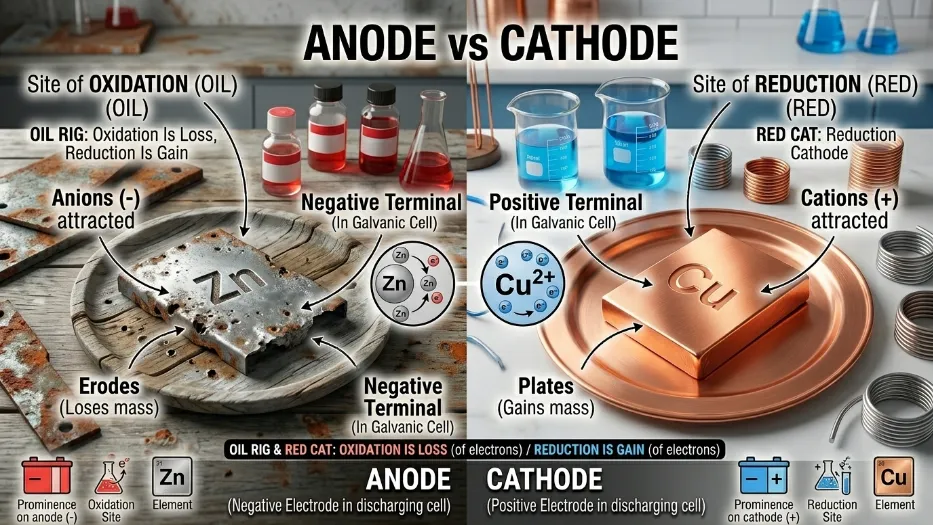
During a school science fair in Rawalpindi, a student proudly displayed a simple battery experiment. When asked how electricity flowed, he paused at two confusing terms Anode and Cathode. This moment clearly showed how tricky the difference between anode and cathode can be. Many learners struggle to grasp the difference between anode and cathode, even though it is fundamental in chemistry and physics. The difference between anode and cathode lies in electron flow and chemical reactions. Understanding the difference between anode and cathode is essential for students, engineers, and anyone working with electrical systems.
Key Difference Between the Both
The main difference is that the anode is where oxidation occurs (loss of electrons), while the cathode is where reduction occurs (gain of electrons).
Why Is Their Difference Important?
Knowing this difference is crucial in science, technology, and industry. It helps in understanding batteries, electrolysis, and electronic devices, which are essential parts of modern society.
Pronunciation
- Anode
- US: /ˈænoʊd/
- UK: /ˈænəʊd/
- Cathode
- US: /ˈkæθoʊd/
- UK: /ˈkæθəʊd/
Now, let’s explore their differences in detail.
Difference Between the Keywords
1. Definition
Anode is the electrode where oxidation happens. Cathode is where reduction happens.
- Example 1: Anode loses electrons.
- Example 2: Cathode gains electrons.
2. Electron Flow
Electrons flow from anode to cathode.
- Example 1: In batteries, electrons leave the anode.
- Example 2: They enter the cathode.
3. Charge in Electrochemical Cells
Anode is negative in galvanic cells. Cathode is positive.
- Example 1: Battery anode is negative.
- Example 2: Battery cathode is positive.
4. Charge in Electrolytic Cells
Anode is positive. Cathode is negative.
- Example 1: Electrolysis anode attracts anions.
- Example 2: Cathode attracts cations.
5. Reaction Type
Anode undergoes oxidation. Cathode undergoes reduction.
- Example 1: Metal loses electrons at anode.
- Example 2: Ions gain electrons at cathode.
6. Role in Batteries
Anode supplies electrons. Cathode receives electrons.
- Example 1: Anode powers the circuit.
- Example 2: Cathode completes the circuit.
7. Material Change
Anode material may dissolve. Cathode material may deposit.
- Example 1: Zinc dissolves at anode.
- Example 2: Copper deposits at cathode.
8. Ion Movement
Anions move to anode. Cations move to cathode.
- Example 1: Negative ions go to anode.
- Example 2: Positive ions go to cathode.
9. Energy Role
Anode releases energy. Cathode consumes energy.
- Example 1: Oxidation releases energy.
- Example 2: Reduction uses energy.
10. Mnemonic
“AN OX” for anode oxidation. “RED CAT” for cathode reduction.
- Example 1: Students remember anode easily.
- Example 2: Cathode becomes easier to recall.
Nature and Behaviour
Anode behaves as an electron donor. It initiates reactions by releasing electrons.
Cathode behaves as an electron receiver. It completes reactions by accepting electrons.
Why People Are Confused
People are confused because the charge of anode and cathode changes depending on the type of cell (galvanic vs electrolytic). This makes learning more complex.
Comparison Table
| Feature | Anode | Cathode | Similarity |
| Reaction | Oxidation | Reduction | Electrodes |
| Electron Role | Donor | Receiver | Part of circuit |
| Charge (Battery) | Negative | Positive | Work together |
| Ion Attraction | Anions | Cations | Chemical reactions |
| Function | Releases electrons | Accepts electrons | Energy flow |
Which Is Better in What Situation?
Anode:
Anode is essential when the system needs to release electrons and start a reaction. It plays a key role in energy generation in batteries. Without the anode, no current can flow. It is crucial in processes like corrosion and electrolysis.
Cathode:
Cathode is vital when electrons need to be accepted to complete a circuit. It is important in storing and using electrical energy. In devices like rechargeable batteries, the cathode ensures stability and functionality.
Metaphors and Similes
- Anode is like a “giver.”
- Cathode is like a “receiver.”
- Anode releases electrons like a flowing river.
- Cathode absorbs electrons like a sponge.
Connotative Meaning
- Anode: Neutral (source, release)
- Example: “The anode symbolizes giving energy.”
- Cathode: Positive (completion, acceptance)
- Example: “The cathode represents balance.”
Idioms and Proverbs
(No direct idioms exist, but adapted:)
- “Give and take”
- Example: Anode and cathode follow a give and take system.
- “Two sides of the same coin”
- Example: They are two sides of the same coin.
Works in Literature
- The Disappearing Spoon – Science, Sam Kean, 2010
- A Brief History of Time – Science, Stephen Hawking, 1988
Movies Related to Themes
- The Current War (2017, USA)
- Tesla (2020, USA)
FAQs
1. What is the main difference?
Anode loses electrons, cathode gains electrons.
2. Is anode always negative?
No, it depends on the type of cell.
3. Which attracts positive ions?
Cathode attracts cations.
4. Why is it confusing?
Because charges change in different systems.
5. Are both necessary?
Yes, both are essential for current flow.
Usefulness in Surroundings
Both anode and cathode are essential in batteries, electronics, and industrial processes. They power devices and support modern technology.
Final Words
Anode begins the process. Cathode completes it. Exactly. It is a continuous loop of giving and receiving. Because it is a cycle, you cannot have one without the other the moment the anode stops releasing electrons, the cathode has nothing to receive, and the entire system instantly goes dead.
To visualize how this process begins and ends, it helps to look at the physical journey of an electron and the microscopic actions happening at each electrode.
Phase 1: The Anode Begins the Process
The anode is the origin point of the electrical current. At this electrode, a chemical reaction called oxidation takes place.
- The Microscopic Action: The atoms or molecules at the anode are unstable in their current state or are being forced by an external power source to shed weight. They literally split apart, stripping themselves of one or more electrons.
- The Result: The newly freed electrons are pushed out of the anode and enter the wire or circuit, creating a negative electrical charge that wants to move. The remaining oxidized atoms often dissolve into the surrounding fluid (electrolyte) as positively charged ions.
Phase 2: The Medium (The Electrolyte and Circuit)
Before the cathode can finish the job, the energy has to travel.
- Electrons take the high road: they travel through the external wire, powering your phone screen, lightbulb, or motor along the way.
- Ions take the low road: the positively charged ions left behind at the anode swim through a chemical medium called the electrolyte to meet up with the cathode.
Phase 3: The Cathode Completes It
The cathode is the destination. At this electrode, a chemical reaction called reduction takes place.
- The Microscopic Action: The material at the cathode is hungry for electrons. As the electrons finish their journey through your device’s circuit, they arrive at the cathode.
- The Result: The cathode accepts these incoming electrons. At the exact same time, the positive ions that swam through the electrolyte arrive here too. The cathode combines the incoming electrons and the waiting ions to form a new, stable molecule or deposit a fresh layer of metal. The process is now complete.
The Big Picture
Think of it like a crowded airport:
The Cathode is the Arrival Gate: The electrons land, step off the plane, and reunite with their families (combine with ions to complete the reaction).
The Anode is the Departure Gate: Electrons pack up, say goodbye, and board the flight (enter the circuit).
The Wire is the Flight Path: The electrons do the heavy work of flying through the air (powering the device).
Conclusion
The difference between anode and cathode is fundamental to understanding electricity and chemistry. While the anode releases electrons through oxidation, the cathode accepts them through reduction. Together, they create a complete system that powers countless devices in our daily lives. By understanding their roles, learners and professionals can better grasp how energy flows and how modern technology functions. Both are equally important and work together to make electrical systems efficient and effective.
1. The Chemistry: Oxidation vs. Reduction
The easiest way to remember who does what is through two classic chemical acronyms: OIL RIG (Oxidation Is Loss, Reduction Is Gain) and An Ox / Red Cat.
- The Anode (An Ox = Anode Oxidation): This is the electrode where oxidation takes place. The material at the anode loses electrons. As these electrons are stripped away, they travel out of the anode and into the external circuit.
- The Cathode (Red Cat = Reduction Cathode): This is the electrode where reduction takes place. The material here gains the electrons that have traveled through the circuit.
2. The Flow of Energy (Electrons vs. Current)
This is where physics and engineering history can make things slightly confusing.
- Electron Flow: Because the anode loses electrons and the cathode gains them, electrons always physically flow from the anode to the cathode through the external circuit.
- Conventional Current: In physics, “current” is traditionally defined as the flow of positive charge. Because electrons are negative, conventional current is written as flowing in the exact opposite direction: from the cathode to the anode.
3. The Great Polarity Flip: Galvanic vs. Electrolytic
If you ask someone “Is the anode positive or negative?”, the correct scientific answer is actually: It depends on whether you are discharging power or charging up.
A. Galvanic (Voltaic) Cells Discharging Power
Think of a standard AA alkaline battery powering a remote control, or a lithium-ion battery draining while you use your phone.
- The reaction is spontaneous; the chemical energy is actively being converted into electrical energy.
- Anode is Negative (-): Because electrons are being generated here via oxidation, it builds up a negative charge.
- Cathode is Positive (+): It attracts the negative electrons flowing through the wire.
B. Electrolytic Cells Recharging / Power Consumption
Think of plugging your phone into the wall to recharge it, or the industrial process of electroplating chrome onto metal.
- An external voltage source is forcing a non-spontaneous chemical reaction to happen backwards.
- Anode is Positive (+): The external power source pulls electrons away from this electrode, forcing oxidation to happen.
- Cathode is Negative (-): The external source pumps electrons into this electrode, forcing reduction.
| Cell Type | Anode Charge | Cathode Charge | Energy Action | Example |
| Galvanic / Voltaic | Negative (-) | Positive (+) | Generates electricity | Discharging battery |
| Electrolytic | Positive (+) | Negative (-) | Consumes electricity | Recharging battery / Electroplating |
4. Why This Harmony Matters
As you noted, neither can exist without the other. If you break the circuit or stop the chemical reaction at the anode, the cathode instantly starves for electrons, and the flow of electricity grinds to a halt.
Understanding this distinction is what allows engineers to design better electric vehicle batteries, allows chemists to prevent rust (by using a “sacrificial anode” to protect ships), and allows tech companies to develop faster charging cycles for the devices we use every day.

I am a professional SEO content writer specialising in comparison-based and grammar-focused articles. Through my website GrammarCompare.com, I help readers clearly understand the difference between confusing terms with well-researched, easy-to-read content. My expertise lies in focusing on clarity, accuracy, and practical explanations that improve both knowledge and writing skills.