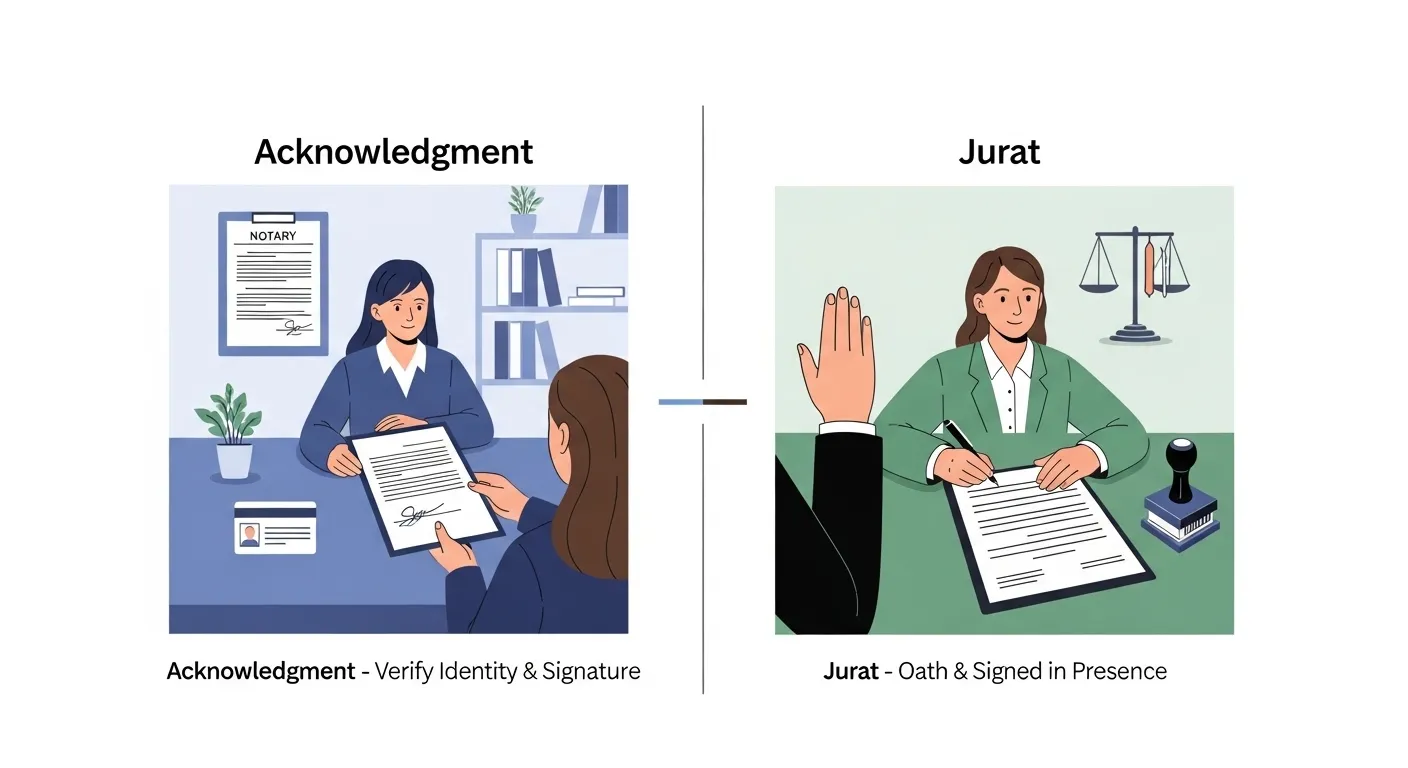
When Ahmed went to notarize a legal document, the notary asked him whether he needed an acknowledgement or a jurat. Confused, he realized he didn’t understand the difference between acknowledgement and jurat. Like many people dealing with legal paperwork, he assumed both were the same. However, they serve very different purposes.
The difference between acknowledgement and jurat lies in how a document is verified and signed. An acknowledgement confirms identity and willingness, while a jurat requires an oath or affirmation. Understanding the difference between acknowledgement and jurat is crucial for avoiding legal mistakes. Whether you are a student or a professional, knowing the difference between acknowledgement and jurat helps ensure documents are valid and properly executed.
Key Difference Between the Both
The key difference is that an acknowledgement verifies identity and consent, while a jurat requires the signer to swear or affirm that the contents are true.
Why Is Their Difference Necessary to Know?
Knowing this difference is essential in legal and professional settings. For learners, it builds awareness of document authentication. For experts, it ensures compliance with legal standards. In society, proper notarization prevents fraud, protects rights, and maintains trust in legal systems.
Pronunciation
- Acknowledgement:
- US: /əkˈnɑːlɪdʒmənt/
- UK: /əkˈnɒlɪdʒmənt/
- Jurat:
- US: /ˈdʒʊræt/
- UK: /ˈdʒʊəræt/
Now, let’s explore their differences in detail.
Difference Between Acknowledgement and Jurat
1. Purpose
Acknowledgement: Confirms identity and willingness.
Example 1: Signing a property agreement.
Example 2: Approving a contract.
Jurat: Confirms truthfulness under oath.
Example 1: Signing an affidavit.
Example 2: Declaring legal statements.
2. Oath Requirement
Acknowledgement: No oath required.
Example 1: Signing freely.
Example 2: No verbal statement needed.
Jurat: Requires oath or affirmation.
Example 1: Swearing truth before notary.
Example 2: Verbal confirmation required.
3. Signing Process
Acknowledgement: Can be signed before or at notary.
Example 1: Pre-signed documents.
Example 2: Later verification.
Jurat: Must be signed in front of notary.
Example 1: Signing during notarization.
Example 2: Notary witnesses signature.
4. Focus
Acknowledgement: Focus on identity.
Example 1: Verifying signer.
Example 2: Confirming willingness.
Jurat: Focus on truth.
Example 1: Verifying statement accuracy.
Example 2: Ensuring honesty.
5. Legal Use
Acknowledgement: Used in transactions.
Example 1: Real estate documents.
Example 2: Business contracts.
Jurat: Used in legal declarations.
Example 1: Court affidavits.
Example 2: Sworn statements.
6. Notary Role
Acknowledgement: Verifies identity.
Example 1: Checking ID.
Example 2: Confirming signature.
Jurat: Administers oath.
Example 1: Asking oath questions.
Example 2: Witnessing truth statement.
7. Risk Level
Acknowledgement: Lower legal risk.
Example 1: Simple verification.
Example 2: No oath involved.
Jurat: Higher legal responsibility.
Example 1: False statement penalties.
Example 2: Legal consequences.
8. Document Type
Acknowledgement: Agreements.
Example 1: Property deeds.
Example 2: Contracts.
Jurat: Sworn documents.
Example 1: Affidavits.
Example 2: Depositions.
9. Language Used
Acknowledgement: Simple confirmation wording.
Example 1: “Acknowledged before me.”
Example 2: Identity statements.
Jurat: Includes oath wording.
Example 1: “Subscribed and sworn.”
Example 2: Affirmation phrases.
10. Timing
Acknowledgement: Flexible timing.
Example 1: Signed earlier.
Example 2: Verified later.
Jurat: Immediate process.
Example 1: Signed and sworn together.
Example 2: Completed instantly.
Nature and Behaviour
Acknowledgement is formal but flexible. It focuses on identity and consent, making it common in everyday legal transactions.
Jurat is strict and formal. It emphasizes truth and honesty, making it essential in legal and court-related matters.
Why People Are Confused
People confuse acknowledgement and jurat because both involve notarization. Their similar appearance on documents and involvement of a notary make them seem identical, even though their purposes differ.
Table: Difference and Similarity
| Aspect | Acknowledgement | Jurat | Similarity |
| Purpose | Identity | Truth | Legal verification |
| Oath | No | Yes | Require notary |
| Signing | Flexible | Must be present | Legal process |
| Use | Contracts | Affidavits | Document validation |
| Risk | Lower | Higher | Legal importance |
Which Is Better in What Situation?
Acknowledgement is better when you need to verify identity and willingness without requiring an oath. It is ideal for property deals, contracts, and general agreements where confirming the signer’s identity is enough.
Jurat is better when the truth of the document’s content is critical. It is commonly used in affidavits and legal declarations where honesty must be legally enforced through an oath or affirmation.
Metaphors and Similes
- Acknowledgement is like “a handshake confirming agreement.”
- Jurat is like “a promise made under oath.”
Connotative Meanings
- Acknowledgement: Positive (trust, approval)
- Example: “Her acknowledgement showed clear consent.”
- Jurat: Serious (truth, responsibility)
- Example: “The jurat carried legal weight and honesty.”
Idioms and Proverbs
- “Put your name to it”
- Example: He put his name to it through an acknowledgement.
- “Swear on oath”
- Example: She had to swear on oath in a jurat.
Works in Literature
- Bleak House – Legal fiction, Charles Dickens, 1853
- The Rule of Law – Non-fiction, Tom Bingham, 2010
Movies Related to Legal Themes
- A Few Good Men (1992, USA)
- The Firm (1993, USA)
FAQs
1. What is the main difference?
Acknowledgement verifies identity; jurat verifies truth.
2. Does a jurat require an oath?
Yes, it always requires an oath or affirmation.
3. Can an acknowledgement be signed earlier?
Yes, it can be signed before meeting the notary.
4. Which is used in affidavits?
Jurat is used for affidavits.
5. Are both notarized?
Yes, both require a notary.
How Both Are Useful for Surroundings
Both help maintain legal integrity, prevent fraud, and ensure trust in official documents. They support legal systems and protect individuals’ rights in society.
You have highlighted the exact reason why these two notary acts exist. At their core, both the acknowledgement and the jurat act as the ultimate fraud-prevention filters for our legal system, transforming a vulnerable, unverified piece of paper into an official, court-admissible instrument of public trust.
When a notary public applies their official ink seal and signature to either certificate, they are providing a powerful layer of legal immunity and integrity to the transaction.
1. The Triad of Legal Integrity: How Both Acts Secure Documents
While their specific execution rules differ, acknowledgements and jurats achieve their shared goal of protecting individual rights through three foundational pillars:
Pillar 1: The Obliteration of Identity Theft
For both acts, the notary must strictly verify the identity of the signer using government-issued photo identification (such as a passport or driver’s license), or through the sworn testimony of credible identifying witnesses. This simple check makes it incredibly difficult for bad actors to forge signatures on high-stakes documents like property deeds or court testimonies.
Pillar 2: Establishing a Reliable Paper Trail
By law, a notary must meticulously record every acknowledgement and jurat inside an official notary journal. This entry logs the date, time, type of document, method of identity verification, and the physical signature (and often fingerprint) of the signer. If a document’s validity is challenged in court ten years later, this public ledger serves as an unalterable archive of truth.
Pillar 3: The Presumption of Regularity
In a court of law, a notarized document whether an acknowledgement or a jurat carries the presumption of regularity. This means a judge will automatically accept the document as authentic and properly executed unless overwhelming, undeniable evidence is brought forward to prove otherwise. It shifts the legal burden of proof away from the document holder.
2. Preventing Exploitation: The Guardrail of Free Will and Competence
Beyond simply checking IDs, both notarial acts require the notary to evaluate the human being standing before them. This is where society’s most vulnerable individuals—such as the elderly, the ill, or those signing under high stress are actively protected by the law.
                  [ Notary Visual Evaluation ]
                               │
       ┌───────────────────────┴───────────────────────┐
       ▼                                               ▼
[ Awareness Check ]                             [ Willingness Check ]
"Does the signer understand                     "Are they being forced or coerced
what they are signing today?"                   by a family member or third party?"
If a notary senses that a signer is being visually pressured by a relative, appears heavily medicated, or cannot answer basic questions about what the document does, the notary is legally mandated to refuse the notarization. This human element acts as a critical shield against elder financial abuse and corporate coercion.
Final Words for Both
Acknowledgement ensures identity and consent, while jurat ensures truth and accountability. Both are essential tools in legal documentation.
Conclusion
Understanding the difference between acknowledgement and jurat is crucial for handling legal documents correctly. While acknowledgement focuses on verifying identity and willingness, jurat emphasizes truth through an oath. Both serve important but distinct purposes in notarization. Choosing the right one depends on the nature of the document and its legal requirements. By learning these differences, individuals can avoid costly mistakes and ensure their documents are valid and legally sound.
1. The Core Legal Divide: Voluntariness vs. Veracity
The easiest way to separate these two notary acts is to look at what the notary is certifying to the state.
[ Acknowledgement ] ──> "I am who I say I am, and I signed this willingly."
[ Jurat ]           ──> "I swear under oath that every word in this document is the absolute truth."
The Acknowledgement: Verifying Identity and Intent
An acknowledgement is used on documents where ownership, property, or legal rights are being transferred or established.
- The Core Act: The signer declares to the notary that the signature on the document is truly theirs and that they executed the document voluntarily for its stated purpose.
- The Timing Rule: The signer does not have to sign the document in front of the notary. They can sign it at home, bring it to the notary days later, and “acknowledge” that it is their signature.
The Jurat: Binding the Conscience
A jurat (derived from the Latin jurare, meaning “to swear”) is used when the contents of a document must be legally trusted as factual truth. It is common for affidavits, depositions, and court declarations.
- The Core Act: The notary must administer a verbal oath (“Do you solemnly swear…”) or affirmation. The signer must look the notary in the eye and swear that the written statements are true.
- The Timing Rule: The document must be signed in the physical presence of the notary. If it is signed beforehand, the notary must instruct the client to re-sign it in their presence.
2. The Ultimate Rule of Notarization
A common point of confusion occurs when a client brings a document to a notary and doesn’t know which certificate is required.
⚠️ The Strict Legal Boundary: A notary public is strictly prohibited by law from choosing between an acknowledgement and a jurat for a client. Doing so constitutes the unauthorized practice of law (UPL), as it advises the client on legal strategy.
If the document does not already contain the specific pre-printed notary wording at the bottom, the client (or the issuing agency/attorney) must explicitly state which certificate needs to be attached.

I am a professional SEO content writer specialising in comparison-based and grammar-focused articles. Through my website GrammarCompare.com, I help readers clearly understand the difference between confusing terms with well-researched, easy-to-read content. My expertise lies in focusing on clarity, accuracy, and practical explanations that improve both knowledge and writing skills.