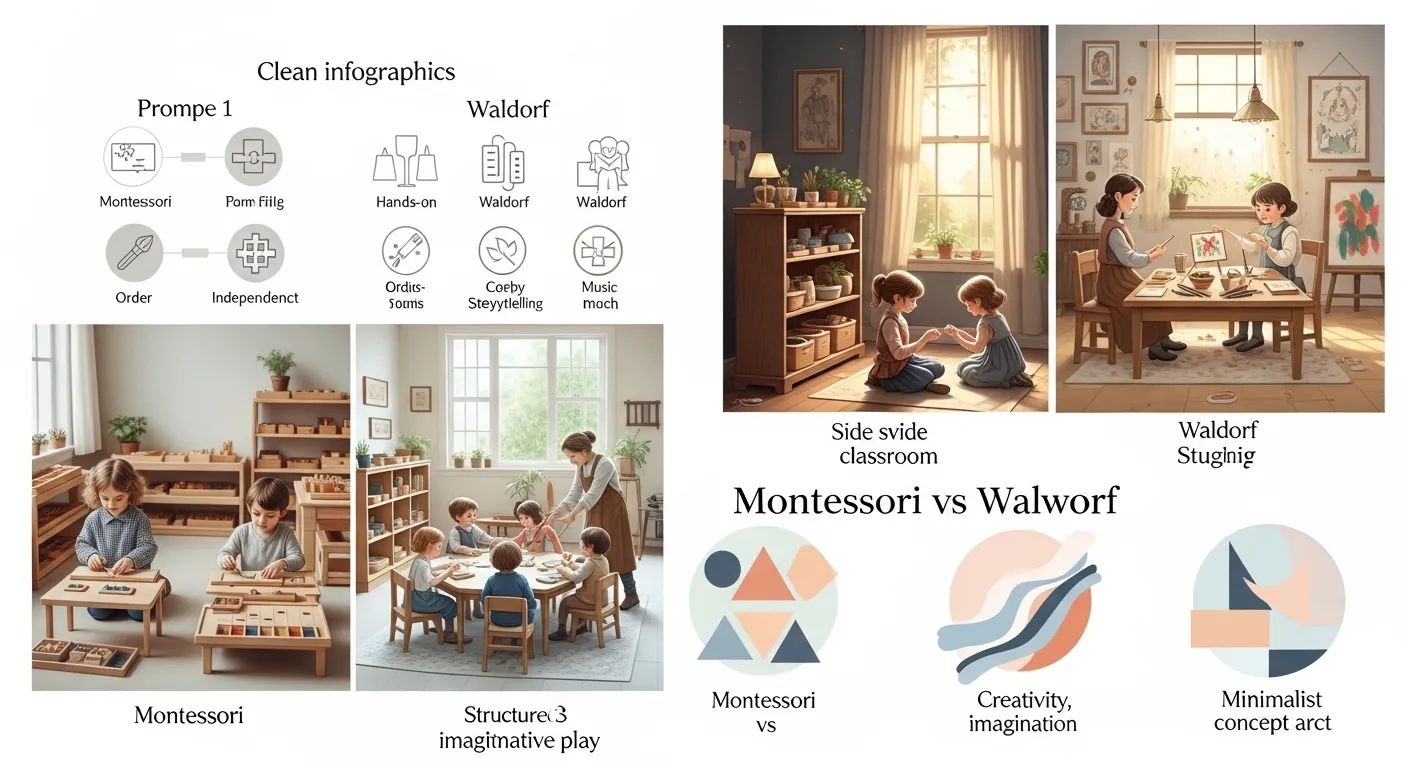
A parent once stood at a crossroads while choosing a school for her child. One school focused on independence and hands-on learning, while the other emphasized imagination, creativity, and storytelling. These approaches represented Montessori and Waldorf education. Understanding the difference between Montessori and Waldorf became essential for her decision.
The difference between Montessori and Waldorf lies in their teaching philosophy, classroom structure, and learning goals. While Montessori encourages self-directed learning, Waldorf nurtures creativity through guided imagination. In today’s world, knowing the difference between Montessori and Waldorf helps parents and educators make informed choices. Whether for early childhood or advanced learning, the difference between Montessori and Waldorf shapes how children grow academically and emotionally.
Key Difference Between the Both
Montessori focuses on independence and practical skills, while Waldorf emphasizes imagination, creativity, and holistic development.
Why Is Their Difference Necessary to Know?
Understanding the difference between Montessori and Waldorf is important for learners and experts because it influences educational outcomes. Montessori prepares children for real-world problem-solving, while Waldorf builds emotional intelligence and creativity. In society, both systems play a vital role—one fosters innovation and independence, while the other nurtures artistic and social growth.
Pronunciation
- Montessori
- US: /ˌmɒntɪˈsɔːri/
- UK: /ˌmɒntɪˈsɒri/
- Waldorf
- US: /ˈwɔːldɔːrf/
- UK: /ˈwɔːldɒf/
Now that we understand the basics, let’s explore the difference between Montessori and Waldorf in detail.
Difference Between Montessori and Waldorf
1. Teaching Philosophy
Montessori is child-centered and focuses on independence. Waldorf is teacher-guided and focuses on imagination.
- Example 1: Montessori child chooses activities freely.
- Example 2: Waldorf teacher tells stories to guide learning.
2. Learning Style
Montessori uses hands-on learning. Waldorf uses storytelling and arts.
- Example 1: Montessori uses puzzles and tools.
- Example 2: Waldorf uses painting and drama.
3. Classroom Environment
Montessori classrooms are structured and organized. Waldorf classrooms are warm and artistic.
- Example 1: Montessori shelves are neatly arranged.
- Example 2: Waldorf rooms have soft colors and handmade items.
4. Role of Teacher
Montessori teachers guide quietly. Waldorf teachers actively lead.
- Example 1: Montessori teacher observes more.
- Example 2: Waldorf teacher interacts constantly.
5. Curriculum Focus
Montessori focuses on practical life and academics. Waldorf focuses on creativity and imagination.
- Example 1: Montessori teaches math early.
- Example 2: Waldorf delays formal academics.
6. Use of Technology
Montessori may allow limited technology. Waldorf avoids it in early years.
- Example 1: Montessori uses digital tools occasionally.
- Example 2: Waldorf prefers no screens.
7. Assessment Method
Montessori uses observation-based assessment. Waldorf avoids formal testing.
- Example 1: Montessori tracks progress individually.
- Example 2: Waldorf focuses on personal growth.
8. Age Grouping
Montessori mixes age groups. Waldorf groups by age.
- Example 1: Montessori class has 3–6-year-olds together.
- Example 2: Waldorf classes are same-age.
9. Materials Used
Montessori uses scientific learning materials. Waldorf uses natural and artistic materials.
- Example 1: Montessori uses counting beads.
- Example 2: Waldorf uses wooden toys.
10. Goal of Education
Montessori aims for independence. Waldorf aims for holistic development.
- Example 1: Montessori builds self-reliance.
- Example 2: Waldorf builds creativity and empathy.
Nature and Behaviour
Montessori is practical, structured, and independent. It encourages logical thinking and discipline.
Waldorf is creative, emotional, and expressive. It focuses on imagination and social harmony.
Why People Are Confused About Their Use?
People often confuse Montessori and Waldorf because both are alternative education systems. They avoid traditional methods, focus on child development, and promote holistic learning. However, their core philosophies are quite different.
Table: Difference and Similarity
| Aspect | Montessori | Waldorf | Similarity |
| Philosophy | Independence | Creativity | Child-centered |
| Teaching Style | Self-directed | Teacher-guided | Active learning |
| Materials | Scientific | Artistic | Hands-on |
| Environment | Structured | Artistic | Supportive |
| Assessment | Observational | Non-testing | Individual growth |
Which Is Better in What Situation?
Montessori:
Montessori is better for children who are independent and curious. It suits learners who enjoy exploring at their own pace. It is ideal for developing practical skills, discipline, and logical thinking.
Waldorf:
Waldorf is better for children who are imaginative and creative. It suits those who enjoy storytelling, art, and emotional expression. It is ideal for nurturing creativity and social skills.
Metaphors and Similes
- Montessori is like a “toolbox” where children build their own skills.
- Waldorf is like a “garden” where creativity grows naturally.
Connotative Meaning
- Montessori: Positive (independence, discipline)
- Example: “Her Montessori mindset made her self-reliant.”
- Waldorf: Positive (creativity, imagination)
- Example: “His Waldorf-style thinking inspired innovation.”
Idioms or Proverbs
- “Learn by doing” (fits Montessori)
- Example: Children in Montessori truly learn by doing.
- “Imagination knows no bounds” (fits Waldorf)
- Example: Waldorf students show that imagination knows no bounds.
Works in Literature
- The Montessori Method – Educational, Maria Montessori, 1912
- Education of the Child – Philosophy, Rudolf Steiner, 1907
Movies Related to Keywords
- Maria Montessori: Una Vita per i Bambini (2007, Italy)
- Being and Becoming (2014, France)
FAQs
1. What is the main difference between Montessori and Waldorf?
Montessori focuses on independence, while Waldorf focuses on creativity.
2. Which is better for early education?
Both are effective; choice depends on the child’s personality.
3. Do both systems avoid exams?
Yes, both prefer alternative assessment methods.
4. Is technology used in both?
Montessori allows limited use; Waldorf avoids it early on.
5. Which develops creativity more?
Waldorf emphasizes creativity more strongly.
How Both Are Useful for Surroundings
Montessori develops problem-solvers who contribute to society. Waldorf nurtures creative thinkers who bring innovation and empathy. Together, they create a balanced and progressive environment.
Final Words for Both
Montessori builds independence and discipline. Waldorf builds imagination and emotional intelligence. Both are valuable in shaping future generations.
Conclusion
The difference between Montessori and Waldorf lies in their unique philosophies and teaching approaches. Montessori emphasizes independence, structure, and practical skills, while Waldorf focuses on creativity, imagination, and emotional growth. Understanding the difference between Montessori and Waldorf helps parents and educators choose the best path for a child’s development. Both systems contribute significantly to education by nurturing different aspects of human potential. Ultimately, the choice depends on the child’s needs, personality, and learning style, making both approaches equally important in modern education. Expanding on the distinction between the Montessori and Waldorf models, we can analyze how their founding philosophies translate into entirely different classroom environments, daily rhythms, and roles for the educator.
While both systems reject traditional standardized testing and rote memorization, they approach early childhood development from opposite ends of the developmental spectrum.
1. The Classroom Environment: Structured Independence vs. Imaginative Harmony
- Montessori (The Prepared Environment): A Montessori classroom is highly organized, minimalist, and analytical. Learning materials are arranged neatly on low, open shelves, and each item has a specific, self-correcting educational purpose. Children work independently, choosing their own tasks (called “work”) and spreading them out on individual floor mats or small tables. The aesthetic is clean, precise, and deeply anchored in the real world—using real, breakable glass pitchers for pouring practice and anatomically correct puzzles.
- Waldorf (The Domestic Sanctuary): A Waldorf classroom is designed to mimic a warm, home-like environment. The aesthetic is soft, pastel-toned, and explicitly avoids hard angles or sterile organization. Toys are simple, open-ended, and made exclusively from natural materials—such as unspun wool, pinecones, wood blocks, and faceless rag dolls. This lack of detail is intentional, designed to force the child to use their own imagination to assign emotions, functions, and stories to the objects during free play.
2. The Daily Curriculum: Child-Led Realism vs. Teacher-Led Rythm
- Montessori (Practical Life & Academics): Montessori introduces academic concepts—such as reading, writing, and mathematical bead chains—at a very early age (often around 3 or 4 years old), but only when the individual child shows a natural readiness. The curriculum heavily features “Practical Life” skills, teaching children how to sweep floors, preparation real food, button their own clothes, and care for their environment. Fantasy and fairy tales are generally discouraged in the early years in favor of exploring real-world science, geography, and history.
- Waldorf (Art, Myth, and Delayed Academics): Waldorf intentionally delays formal academic instruction (reading, writing, and math) until around age 7 (first grade), believing that early childhood energy should be entirely preserved for physical and imaginative growth. Instead, the early years are filled with oral storytelling, puppet shows, watercolor painting, cooking, and rhythmic movement (called Eurythmy). The curriculum tracks the changing seasons and incorporates rich mythology, folklore, and fairy tales to nurture the child’s emotional and spiritual world.
3. The Role of the Educator and Peer Group
- Montessori (The Observer & Director): In a Montessori setting, the teacher acts as a quiet guide or facilitator. They rarely lecture to the whole room; instead, they move quietly between individual children, observing their progress and introducing new materials only when the child is ready. Classrooms are multi-age (typically spanning 3-year age blocks), allowing older children to naturally mentor younger ones and reinforcing a sense of community.
- Waldorf (The Storyteller & Role Model): The Waldorf teacher takes a central, highly active role in leading the group. The entire class moves through the day together in a shared rhythm of “breathing in” (focused group activities like singing or baking) and “breathing out” (unstructured creative play). In standard Waldorf schools, a single teacher will often stay with the exact same cohort of children for up to eight years, forming a deep, parental bond and a highly stable social environment.
Core Philosophical Comparison
| Feature | Montessori Approach | Waldorf Approach |
| Founder & Origin | Dr. Maria Montessori (Italy, 1907) – Rooted in scientific observation of underprivileged children. | Rudolf Steiner (Germany, 1919) – Rooted in Anthroposophy (a spiritual philosophy of human development). |
| Core Value | Independence and Competence (“Help me do it myself”). | Creativity and Empathy (“Nurture the head, heart, and hands”). |
| Learning Style | Individualized, self-paced, and task-oriented. | Group-centered, artistic, and rhythm-oriented. |
| View on Fantasy | Prefers real-world exploration; believes fantasy can confuse young minds. | Views imagination, fairy tales, and magical thinking as essential for emotional health. |
| Technology/Media | Discouraged during work periods; focus is on tangible, tactile learning materials. | Strictly discouraged both at school and at home to preserve the child’s natural imagination. |
Summary: Ultimately, Montessori looks at a child and sees a natural scientist capable of mastering their physical world through logic, independence, and order. Waldorf looks at a child and sees an artist whose spirit must be protected and nurtured through beauty, rhythm, and communal imagination. Choosing between them is a matter of deciding whether your child’s personality thrives best under freedom within a structured reality, or safety within a creative sanctuary.

I am a professional SEO content writer specialising in comparison-based and grammar-focused articles. Through my website GrammarCompare.com, I help readers clearly understand the difference between confusing terms with well-researched, easy-to-read content. My expertise lies in focusing on clarity, accuracy, and practical explanations that improve both knowledge and writing skills.