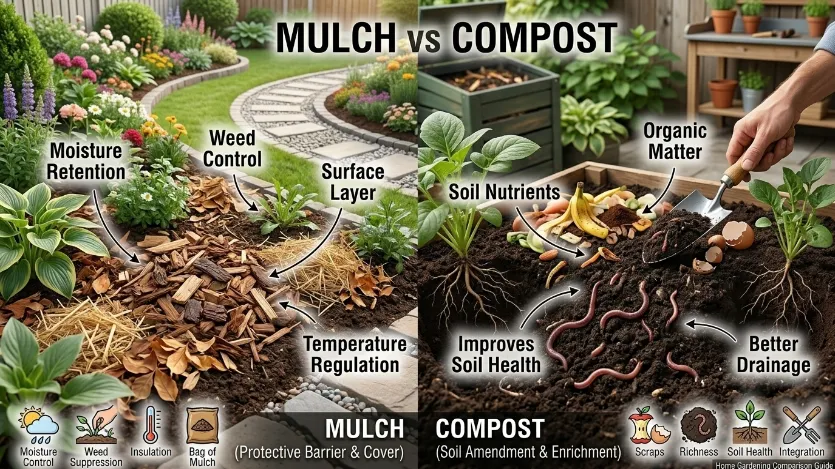
A neighbor in Islamabad once struggled to grow healthy plants despite watering them daily. One day, a gardener suggested using Mulch and Compost. At first, the terms sounded similar, but the difference between mulch and compost soon became clear. The difference between mulch and compost lies in their purpose one protects the soil, while the other enriches it. Understanding the difference between mulch and compost helped transform that dull garden into a green paradise. For beginners and experts alike, knowing the difference between mulch and compost is essential for better gardening and sustainable living.
To truly master the difference between these two components, it helps to look at them as a complete, self-sustaining system. When applied correctly, they work in tandem to dramatically reduce your workload meaning less watering, less weeding, and less reliance on chemical fertilizers.
Here is a deeper look into the science, application, and specific strategies for using mulch and compost effectively.
1. Compost: The Soil Engine
Compost is organic matter that has undergone a biological decomposition process driven by beneficial bacteria, fungi, and micro-organisms. It is essentially nature’s ultimate recycling mechanism.
How it Works Internally
- Soil Aggregation: Compost contains humus (complex organic compounds that cannot break down further). Humus acts like a natural glue, binding microscopic soil particles into larger aggregates. This creates a sponge-like structure in clay soils (allowing air and water to penetrate) and gives body to sandy soils (preventing water from washing straight through).
- The Biological Supercharge: Beyond raw nutrients (Nitrogen, Phosphorus, and Potassium), compost introduces billions of microbes. These organisms form symbiotic relationships with plant roots, breaking down tightly bound minerals and delivering them directly to the plant in an easily absorbable form.
Common Varieties & Choices
- Leaf Mold: Simply piled leaves left to decompose into a dark, crumbly texture. It is exceptional for improving soil structure, though lower in nitrogen.
- Mushroom Compost: A byproduct of the mushroom farming industry, usually made from straw, peat moss, and chalk. It is highly rich but can be slightly alkaline.
- Vermicompost (Worm Castings): Produced by worms digesting organic matter. This is highly concentrated, packed with enzymes, and serves as an elite fertilizer for delicate root zones.
2. Mulch: The Climate Armor
While compost interacts biologically with the soil, mulch acts mechanically on top of it. Its purpose is to insulate, block light, and physically shield the earth.
The Microclimate Effect
- Temperature Moderation: Soil microbes thrive in a narrow temperature window. Unprotected topsoil can reach temperatures well above 40°C on a hot afternoon, effectively sterilizing the top inch of your soil. A dense layer of mulch keeps the soil below significantly cooler in the summer and warmer during chilly winter nights.
- The Weed Barrier: Most weed seeds require direct sunlight to trigger germination. A 2 to 3-inch layer of mulch denies them light. Any weeds that do manage to sprout from wind-blown seeds have to fight through the loose mulch, making their root systems weak and incredibly easy to pull out by hand.
Common Varieties & Choices
- Wood Chips and Bark Shavings: Excellent for permanent landscape beds, trees, and shrubs. They take a long time to break down, meaning you only need to refresh them once a year.
- Straw or Clean Hay: The go-to choice for vegetable gardens. It is clean, easy to spread around fragile plants, and reflects intense sunlight well.
- Grass Clippings and Shredded Leaves: A free, readily available option. As they decompose, they return mild nutrients to the soil surface, though they must be applied loosely so they don’t mat together and block water flow.
The Pro-Gardener Application Strategy
To get the absolute maximum benefit from both materials, they should be applied in a specific order during your seasonal garden preparation.
1.Prepare the Bed:Step 1.
Clear out any active weeds and lightly loosen the existing top layer of soil with a garden fork. Do not aggressively till, as this disrupts existing fungal networks.
2.Apply the Compost Layer:Step 2.
Spread a 1 to 2-inch layer of mature compost over the entire bed. You can gently scratch it into the top few inches of your soil, or leave it right on top to let earthworms pull it down naturally over time.
3.Plant and Water Thoroughly:Step 3.
Put your plants or seeds into the ground. Water the entire bed deeply right now. It is much easier to thoroughly hydrate the bare soil and compost layer before the mulch goes on.
4.Cuff the Plants:Step 4.
Leave a small, 1-inch ring of clear space immediately around the base of your plant stems or tree trunks. Never let mulch pile up directly against a plant stem, as the trapped moisture can cause rot or invite fungal disease.
5.Lay the Mulch Blanket:Step 5.
Spread a 2 to 3-inch layer of your chosen mulch over the remaining bare areas. Smooth it out evenly to ensure there are no thin spots where sunlight can penetrate to feed weed seeds.
Key Difference Between the Both
Mulch is used to cover and protect the soil surface, while compost is used to improve soil fertility by adding nutrients.
Why Is Their Difference Important?
Knowing the difference helps gardeners, farmers, and environmentalists improve plant growth, conserve water, and reduce waste. It plays a vital role in sustainable agriculture and eco-friendly living.
Pronunciation
- Mulch
- US: /mʌltʃ/
- UK: /mʌltʃ/
- Compost
- US: /ˈkɑːmpoʊst/
- UK: /ˈkɒmpɒst/
Now, let’s explore their detailed differences to understand how each contributes to a thriving garden.
Difference Between the Keywords
1. Purpose
Mulch protects soil. Compost nourishes soil.
- Example 1: Mulch keeps moisture in the ground.
- Example 2: Compost adds nutrients for plant growth.
2. Placement
Mulch is spread on top. Compost is mixed into soil.
- Example 1: Mulch covers garden beds.
- Example 2: Compost is dug into the soil.
3. Composition
Mulch can be organic or inorganic. Compost is always organic.
- Example 1: Mulch can include bark or plastic.
- Example 2: Compost includes food scraps.
4. Function
Mulch controls weeds. Compost improves soil structure.
- Example 1: Mulch blocks sunlight from weeds.
- Example 2: Compost makes soil softer.
5. Nutrient Content
Mulch has little nutrients. Compost is rich in nutrients.
- Example 1: Mulch slowly adds nutrients.
- Example 2: Compost feeds plants directly.
6. Decomposition
Mulch decomposes slowly. Compost is already decomposed.
- Example 1: Mulch lasts longer on soil.
- Example 2: Compost is ready to use.
7. Water Retention
Mulch improves water retention. Compost improves soil absorption.
- Example 1: Mulch reduces evaporation.
- Example 2: Compost helps soil hold water.
8. Temperature Control
Mulch regulates soil temperature. Compost has little effect on temperature.
- Example 1: Mulch keeps soil cool in summer.
- Example 2: Compost mainly enriches soil.
9. Appearance
Mulch looks like a covering layer. Compost looks like dark soil.
- Example 1: Mulch is visible on top.
- Example 2: Compost blends into soil.
10. Usage Time
Mulch is used anytime. Compost is best used before planting.
- Example 1: Mulch can be added anytime.
- Example 2: Compost is added during soil preparation.
Nature and Behaviour
Mulch acts as a protective shield. It controls environment factors like moisture and temperature.
Compost acts as a nutrient booster. It improves soil health and supports plant growth from within.
Why People Are Confused
People confuse them because both are organic materials used in gardening. They often appear similar and are sometimes used together, which adds to the confusion.
Comparison Table
| Feature | Mulch | Compost | Similarity |
| Purpose | Protection | Nutrition | Improve soil |
| Placement | Surface | Mixed in soil | Garden use |
| Nutrients | Low | High | Organic matter |
| Function | Weed control | Soil enrichment | Plant growth |
| Appearance | Covering | Soil-like | Natural material |
Which Is Better in What Situation?
Mulch:
Mulch is better when you want to protect soil from extreme weather, reduce weeds, and conserve water. It is ideal for garden beds, pathways, and around trees. If your goal is to maintain moisture and reduce maintenance, mulch is the best option.
Compost:
Compost is better when your soil lacks nutrients and needs improvement. It is perfect for planting new crops and improving soil fertility. If your focus is plant health and growth, compost is the better choice.
Metaphors and Similes
- Mulch is like a “blanket” for the soil.
- Compost is like “food” for plants.
- Mulch protects like a shield.
- Compost feeds like a meal.
Connotative Meaning
- Mulch: Neutral to positive (protection, care)
- Example: “Mulch shows care for the environment.”
- Compost: Positive (growth, renewal)
- Example: “Compost represents new life.”
Idioms and Proverbs
- “Reap what you sow”
- Example: Using compost, you reap what you sow.
- “Lay the groundwork”
- Example: Compost helps lay the groundwork for plants.
Works in Literature
- Silent Spring – Environmental science, Rachel Carson, 1962
- The Omnivore’s Dilemma – Non-fiction, Michael Pollan, 2006
Movies Related to Themes
- The Biggest Little Farm (2018, USA)
- Kiss the Ground (2020, USA)
FAQs
1. Can mulch turn into compost?
Yes, organic mulch can decompose into compost over time.
2. Which is better for plants?
Both are useful, but for different purposes.
3. Can I use both together?
Yes, compost enriches soil and mulch protects it.
4. Is mulch necessary?
Not always, but it improves soil conditions.
5. How often should compost be added?
Usually once or twice a year.
Usefulness in Surroundings
Both mulch and compost help maintain green spaces, reduce waste, and improve environmental sustainability. They support healthier plants and cleaner surroundings.
Final Words
Mulch protects and preserves. Compost nourishes and transforms.
Conclusion
The difference between mulch and compost is essential for anyone interested in gardening or sustainable living. While mulch acts as a protective layer that conserves moisture and controls weeds, compost enriches the soil with vital nutrients. Together, they create a balanced system that supports healthy plant growth. Understanding their roles allows gardeners to make better decisions and achieve long-term success. Both are equally important, and using them wisely can turn any garden into a thriving ecosystem.
1. Compost (The Nutrient Booster)
- What it is: Decomposed organic matter (like kitchen scraps, leaves, and manure) that has broken down into dark, rich “black gold.”
- Where it goes: It is meant to be mixed into your existing garden soil or layered directly underneath your top dressing.
- Primary job: It acts as a slow-release fertilizer and soil conditioner. It introduces microbes, improves soil structure, and helps sandy or heavy clay soils hold onto nutrients and moisture more effectively.
2. Mulch (The Protective Blanket)
- What it is: A loose covering of coarser materials like wood chips, bark, straw, or pine needles that breaks down very slowly.
- Where it goes: It sits strictly on top of the soil surface.
- Primary job: It blocks sunlight to prevent weed seeds from germinating, regulates soil temperature against extreme heat or cold, and drastically reduces water evaporation.
The Ultimate Synergy
When you combine them, you maximize your garden’s health. You apply compost first to nourish the root zones, and then cap it with a 1 to 2-inch layer of mulch to lock that goodness in and protect those active soil microbes from drying out under the sun.
If you’d like, we can dive into the best types of mulch for specific plants, or look at how to start a simple composting pile at home.

I am a professional SEO content writer specialising in comparison-based and grammar-focused articles. Through my website GrammarCompare.com, I help readers clearly understand the difference between confusing terms with well-researched, easy-to-read content. My expertise lies in focusing on clarity, accuracy, and practical explanations that improve both knowledge and writing skills.